

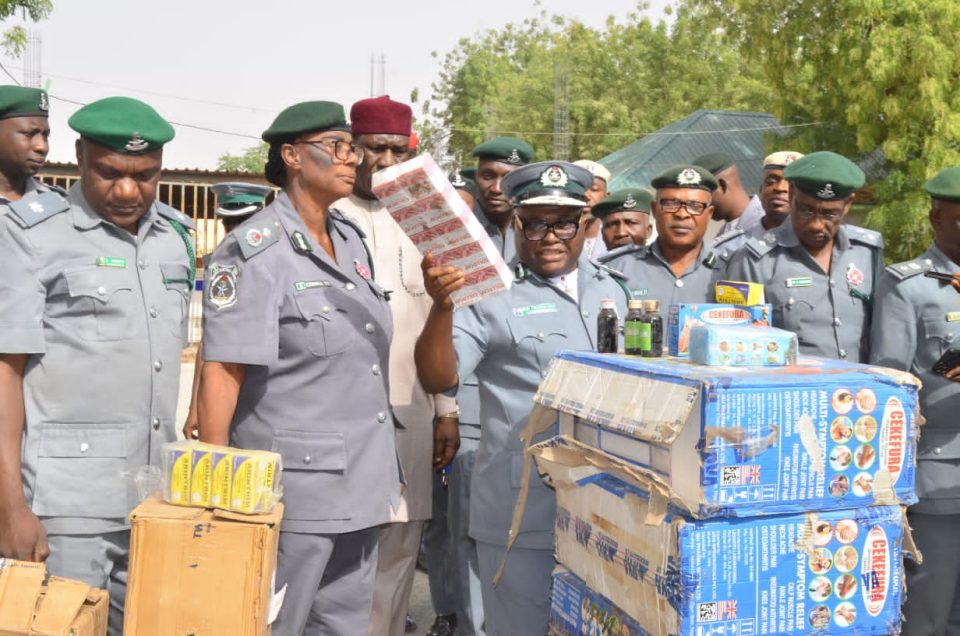
The Nigeria Customs Service (NCS), Seme Area Command, announced on Thursday that it had intercepted contraband goods valued at N1.99 billion between September 1 and October 9, 2025, along the Lagos–Abidjan Corridor. The seized items included illicit drugs and expired flour imported from Egypt.
During his first media briefing at the Seme Border post, the Customs Area Controller, Wale Adenuga, revealed that the expired flour—10,000 bags with a duty-paid value of N1.2 billion—was transported in five trucks. He warned that the products posed serious health risks, including infections, food poisoning, and long-term complications, had they entered local markets.
Seme Border, located in Badagry, Lagos State, is a key entry point into Nigeria from the Benin Republic. It sits on the 1,028-kilometre Lagos–Abidjan Corridor, a strategic highway connecting five West African countries—Nigeria, Benin, Togo, Ghana, and Côte d’Ivoire—and handles approximately 70% of West Africa’s trade. Due to its economic significance, the corridor is also a hotspot for smuggling and cross-border crime.
Adenuga stated that the command has increased its crackdown on smuggling to encourage legal trade. Between early September and October 9, officers seized 1,104 parcels of cannabis sativa and 120 packs of tramadol. Two suspects were transferred to the National Drug Law Enforcement Agency (NDLEA) for further investigation.
Additional confiscated goods during the period included:
- 2,043 bags of foreign parboiled rice (50kg each)
- 150 bales of second-hand clothing
- 169 bottles of codeine-based cough syrup
- Five used vehicles
Adenuga described smuggling as a form of economic sabotage that deprives the nation of vital revenue and threatens public safety. He noted that the resources funneled into illegal trade could otherwise support small businesses and generate employment.
On export activities, the controller disclosed that the Command facilitated non-oil exports totaling 53,989.46 metric tonnes, with a Free on Board (FOB) value of N7.9 billion. The corresponding Nigerian Export Supervision Scheme (NESS) fee amounted to N39.8 million. The exports, consisting of both agricultural and manufactured products, reflect growing exporter confidence in Seme as a viable hub under the ECOWAS Trade Liberalisation Scheme.
In terms of revenue performance, the Command generated N1.5 billion in September 2025—an increase of 182% compared to N531.4 million in August. According to Adenuga, this growth was driven by enhanced trade facilitation, better coordination among agencies, and simplified processes, all in line with Customs modernization efforts.
He reaffirmed the command’s dedication to balancing its responsibilities of revenue collection, trade facilitation, and national security by leveraging intelligence and technology for more effective border management.
Adenuga also expressed appreciation for the Nigerian Navy Forward Operating Base in Badagry for its consistent assistance in intercepting smuggled rice through coastal routes.
His predecessor, Dr. Ben Oramalugo (Rtd), who served as Area Controller from February to September 2025, had also recorded significant seizures, including rice, second-hand clothing, and cannabis. Oramalugo had emphasized the importance of curbing smuggling while promoting lawful non-oil exports along strategic trade routes like the Lagos–Abidjan Corridor.
Despite ongoing efforts, land border smuggling remains a significant challenge—particularly involving commodities such as rice, used clothing, and other restricted goods.