

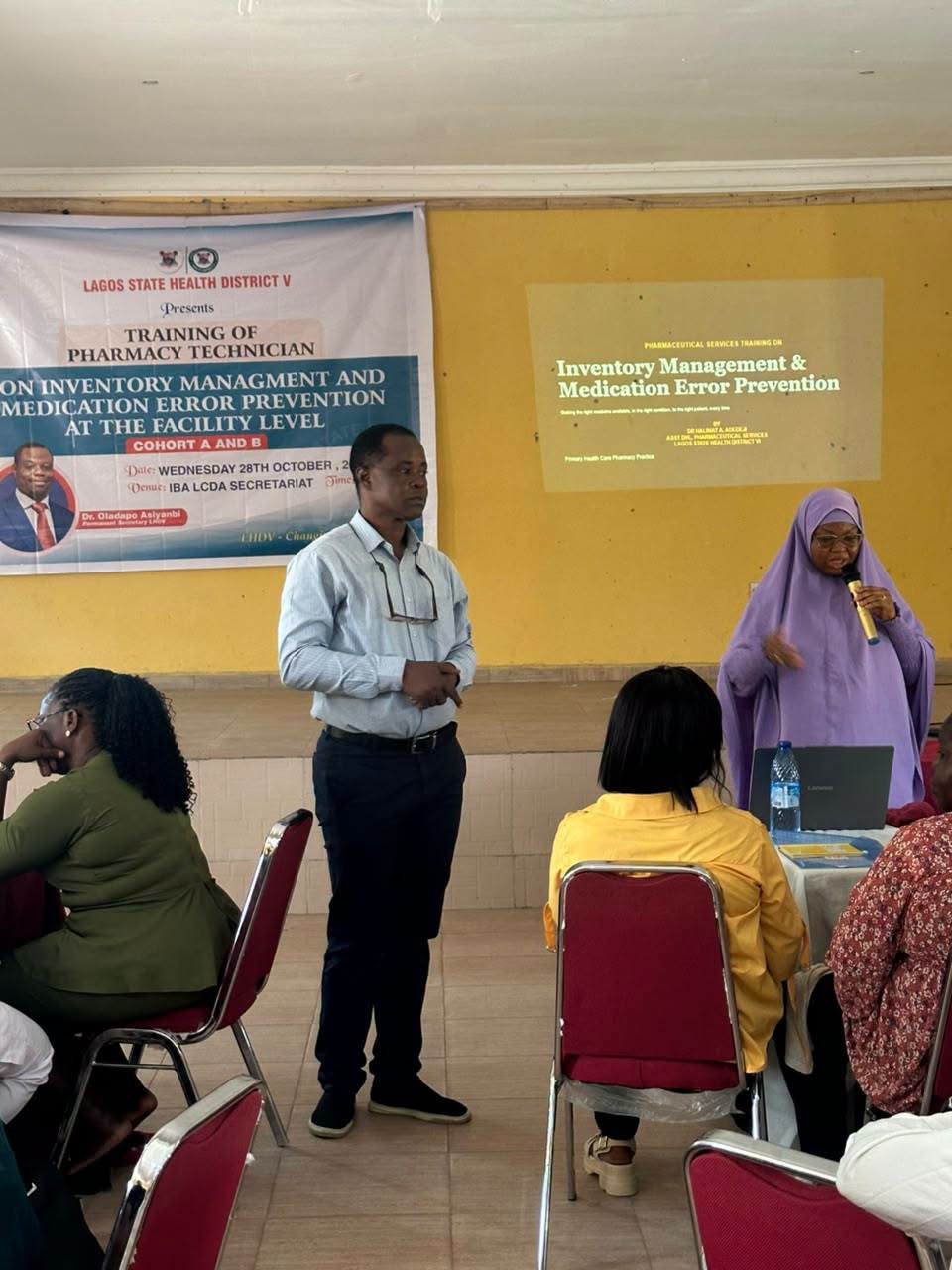
The Lagos State Government has reaffirmed its commitment to improving pharmaceutical services and patient safety through effective medicine inventory management, continuous professional development and strict adherence to medication safety standards.
The Permanent Secretary, Lagos State Health District V, Dr. Oladapo Asiyanbi, gave the assurance during a training programme themed “Inventory Management and Medication Error Prevention at the Facility Level” for Pharmacy Technicians, Cohorts A and B.
The programme, organised by the Directorate of Pharmaceutical Services, Lagos State Health District V, held at Iba Local Council Development Area (LCDA) on Wednesday, October 28, 2026.
Representing the Permanent Secretary, the Director of Medical Services and Disease Control, Dr. Ahmad Amina Bello, emphasised that effective medicine inventory management goes beyond stocktaking and record keeping, noting that it requires proper planning, accurate documentation, regular monitoring of expiry dates and timely availability of essential medicines.
Asiyanbi warned that poor inventory management could result in medicine shortages, unnecessary expenditure, wastage of public resources and disruptions in patient care.
He urged pharmacy personnel to adopt systematic stock-control procedures, maintain accurate inventory records and regularly reconcile stock balances, while applying the First-Expiry, First-Out (FEFO) principle to minimise medicine wastage.
The Permanent Secretary also stressed the need to prevent medication errors, urging healthcare workers to verify prescriptions, confirm patients’ identities, check the correct medicines and dosages, observe appropriate routes of administration and ensure accurate documentation before dispensing or administering medications.
He further highlighted the importance of effective communication and proper handover among healthcare workers, particularly during patient transfers between departments and referrals to other facilities.
Also speaking, the Director of Pharmaceutical Services, Lagos State Health District V, Pharmacist Adekoya Abdulganiu, described the training as an important step towards improving pharmaceutical practice and strengthening accountability in medicine management across healthcare facilities.
He urged pharmacy personnel to remain diligent in monitoring drug stocks, updating inventory records, checking expiry dates and ensuring that medicines are stored and dispensed according to established professional standards.
Abdulganiu also encouraged healthcare professionals to report medication errors and near misses, support appropriate reviews and implement corrective measures to prevent recurrence.
The training was facilitated by Dr. (Pharm.) Halimah Adediji, Assistant Director, Pharmaceutical Services, Mushin Local Government, Lagos State Health District VI, who provided practical guidance on stock monitoring, procurement planning, documentation and stock reconciliation.
Participants were also educated on common causes of medication errors, including incorrect prescriptions, confusion between medicines with similar names or packaging, inaccurate dosage calculations and inadequate verification before dispensing.
The sessions highlighted preventive measures such as prescription screening, proper labelling, patient counselling and strict compliance with medication administration procedures.
The programme further emphasised the importance of maintaining accurate medicine records, including stock levels and pricing information, to support informed procurement decisions, efficient resource management and uninterrupted service delivery across Primary Healthcare (PHC) facilities.
The initiative aligns with the Lagos State Government’s efforts to strengthen healthcare delivery through continuous professional development, efficient resource management and improved access to safe and quality healthcare services.
Lagos State Health District V reiterated its commitment to strengthening the capacity of pharmacy personnel, reducing preventable medication errors, minimising medicine wastage and ensuring patients receive the right medicines in the right doses.