
The Civil Society Scaling-Up Nutrition in Nigeria (CS-SUNN) has launched a Strategic Media Engagement Package in Lagos State to drive domestic nutrition financing, enhance government accountability, and curb maternal and child malnutrition.
Unveiled during a media workshop, the advocacy kit provides journalists with data, budget metrics, and reporting tools to keep nutrition funding at the forefront of public discourse during annual budget deliberations.
Speaking at the launch, CS-SUNN Senior Programme Officer Mrs. Lilian Okafor stressed that sustainable nutrition interventions require robust internal state funding rather than over-reliance on external development partners.
“External organisations and development partners cannot be expected to shoulder the responsibility entirely. Government must prioritise domestic financing,” Okafor stated. She urged media professionals to leverage the new tools to tag relevant government agencies and advocate for expanding high-impact nutrition coverage to 75 per cent by 2030.
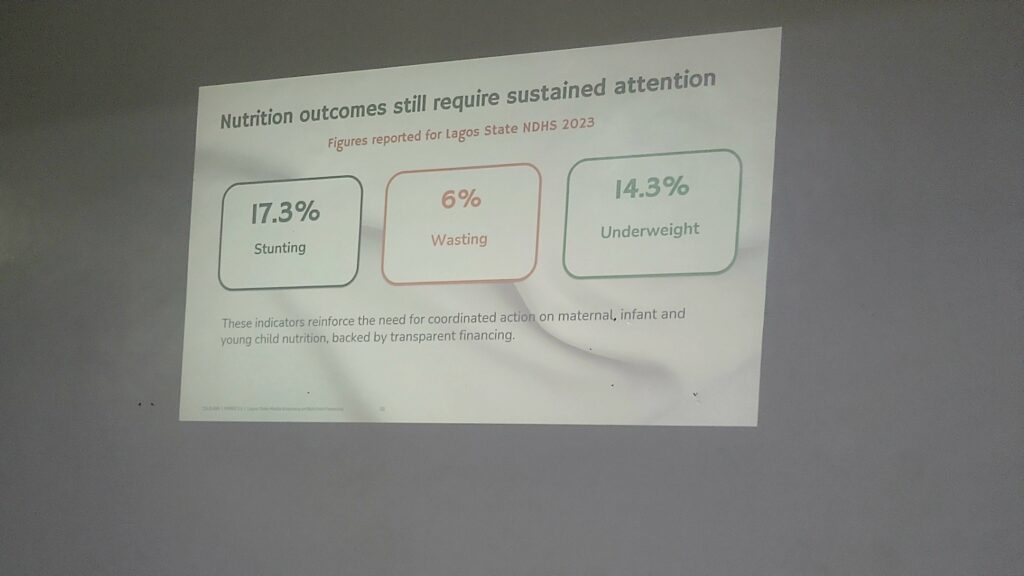
During a technical presentation on Nigeria’s domestic nutrition financing landscape, CS-SUNN Senior Programme Officer, Ambrose Evhoesor highlighted alarming data from the 2023 National Demographic and Health Survey (NDHS). In Lagos State, child health indicators show a 17.3% stunting rate, 6% wasting rate, and 14.3% underweight rate.
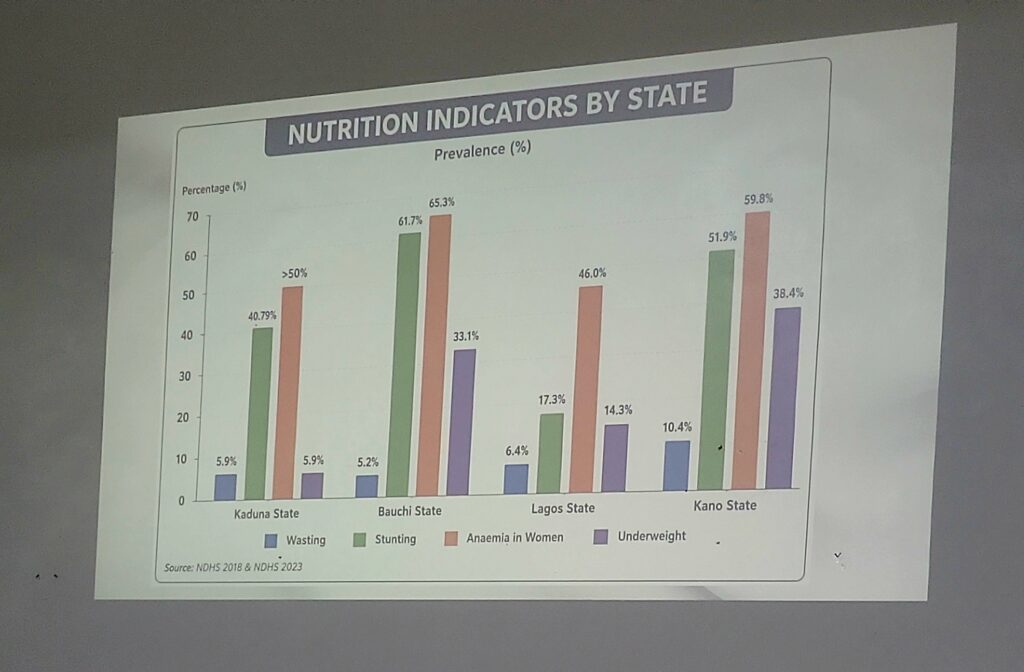
Evhoesor pointed out that Lagos’s wasting rate of 6.4% in specific comparative samples exceeds rates in states like Gombe (5.9%) and Bauchi (5.2%), challenging the assumption that megacity status automatically guarantees superior human development outcomes.
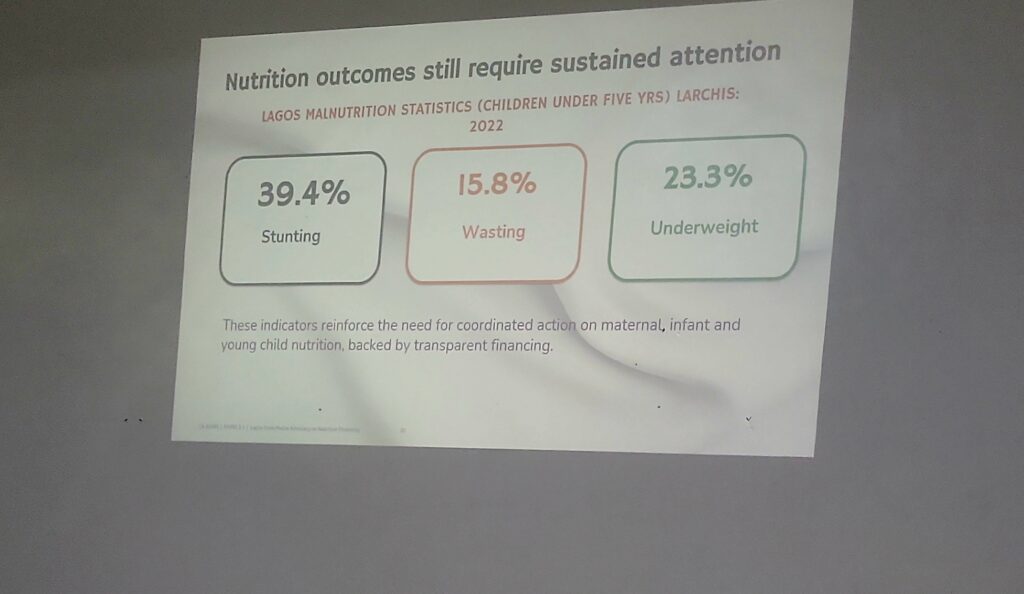
He explained that despite severe acute malnutrition posing a critical threat to children in Lagos State,where 17.3% suffer from stunting, 6% from wasting, and 14.3% are underweight,the state faces a massive funding gap in addressing the crisis. With the cost to treat a single severely malnourished child standing at ₦250,000, the total estimated treatment requirement across Lagos reaches roughly ₦47 billion, starkly eclipsing the 2025 budget allocation of just ₦309 million. Compounding the shortfall is a history of erratic budget performance, which plummeted to a dismal 10% execution rate in 2025 despite a brief high of 81.5% in 2024 and 13% in 2023, leaving life-saving health interventions severely underfunded.
Evhoesor highlighted a massive funding gap: treating a single child with severe acute malnutrition costs roughly ₦250,000, bringing the total estimated treatment requirement in Lagos to ₦47 billion,sharply contrasting with recent state allocations of under ₦600 million. He urged journalists to scrutinize the full budget cycle: “The media must follow the money. It is not enough for government to allocate funds in the budget. The money must be released and properly utilised.”
Addressing the event, State Nutrition Officer for the Lagos State Ministry of Health, Mrs. Taiwo Fadairo, emphasized the critical window of the first 1,000 days of life from conception through a child’s second birthday to prevent irreversible stunting. She noted that Lagos State has decentralized the State Committee on Food and Nutrition into Local Government Committees, with plans to expand structures down to ward and community levels.
Regional CS-SUNN representatives from Kwara and Abia States shared success stories such as the establishment of Local Government Plans of Action across all 16 LGAs and the approval of six months’ paid maternity leave as well as shift in policy toward human capital development alongside physical infrastructure.
Closing the event, CS-SUNN Lagos State Chapter Coordinator Mr. Samuel Akinyode called on journalists to use political debates, candidate interviews and budget hearings to press public Officials for concrete commitments on nutrition funding.