
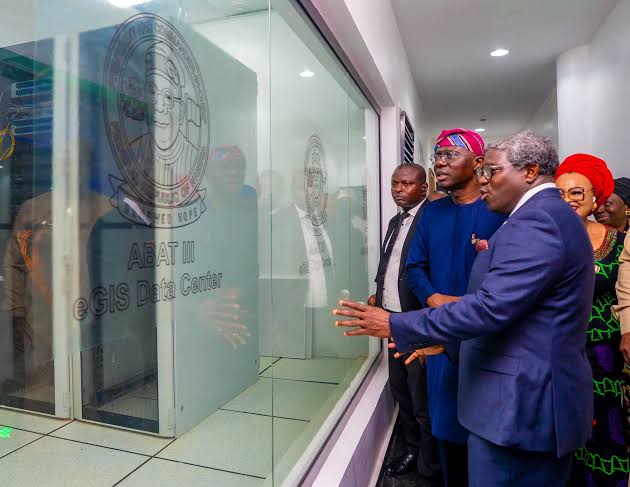
Lagos State Governor, Babajide Sanwo-Olu has unveiled the Bola Ahmed Tinubu III Enterprise Geographic Information System (eGIS) Data Centre at the Lagos State Geographic Information Service (LAGIS) Building in Alausa, Ikeja.
Sanwo-Olu unveiled the facility on Tuesday during the Lagos GIS Day 2026 celebration organised by the Office of the Special Adviser on e-GIS and Urban Development.
The new data centre is designed to strengthen Lagos State’s capacity to create, manage and use spatial information for land administration, urban planning, infrastructure development and other areas of governance.
The development forms part of the state government’s broader push to modernise land administration and expand the use of digital and geospatial data in decision-making.
The Special Adviser to the Governor on e-GIS and Urban Development, Dr Olajide Abiodun Babatunde, said the institutionalisation of LAGIS would provide a stronger framework for managing spatial information across Lagos.
Babatunde said the initiative was not simply about establishing another government facility but about creating a coordinated system through which spatial data could support government planning and service delivery.
The e-GIS programme includes digital mapping infrastructure, spatial-data systems and technology-driven platforms designed to improve the management of land and other resources across the state.
The LAGIS framework is also expected to improve coordination among agencies involved in land administration, physical planning, surveying, valuation and other urban development functions.
The LAGIS Building, a five-storey purpose-built facility, was developed to provide one-stop access to services relating to geospatial mapping, urban planning and land administration. The building was among key Lagos projects unveiled during President Bola Tinubu’s April 2026 visit to the state.
The newly unveiled data centre is expected to provide infrastructure for the storage, management and application of geospatial information while strengthening the state’s ability to use data in planning and managing Lagos.
The development comes as Lagos continues its digital transformation of land administration and urban planning, with the government seeking to reduce reliance on manual processes and improve the efficiency of services available to residents and property owners.